By: Kennia Velázquez, Mónica Cerbón and Arnoldo Cuéllar“They show us how the surveillance system works, and everything seems to be fine. But when you need the information, everything fails: cameras under maintenance, deleted recordings, unusable angles,” says a person who has spent years investigating the disappearance of a family member and who also accompanies dozens of families in the same process. The searcher is intimately familiar with what happens when someone tries to use the video surveillance system to seek justice.
In the last decade, state and municipal governments have invested billions of pesos in video surveillance systems as one of their main responses to violence. The promise is that these technologies would allow for the prevention of crime and strengthen criminal investigations. However, despite sustained investment in these systems, the results have not translated into consistent improvements in security or a reduction in violence.
This technological investment in Mexico has grown in parallel with one of the most violent periods in its recent history. Since 2006, with the start of the federal strategy against drug trafficking, homicides rose from approximately 10,000 cases annually to a peak of over 36,000 in 2020. Although a slight decrease was recorded in 2023, the country remains among the most violent in the world outside of declared war contexts.
For this investigation, the 19 states where the Seguritech Privada group operates were analyzed. These entities accounted for 67,000 of the 91,000 cameras installed in the country up to 2024. In 15 of these 19 states, the homicides increased between 2012 —the year the first contracts with the group began— and 2024, according to data from the National Institute of Statistics, Geography, and Informatics (INEGI in Spanish). The most extreme cases are Guanajuato, with an increase of 490%, and Quintana Roo and Baja California, with increases exceeding 320%. Only four entities registered a reduction: Coahuila, Durango, Chihuahua, and Mexico City. This data shows that sustained investment in these systems did not translate into a consistent improvement in safety in most of the states analyzed.
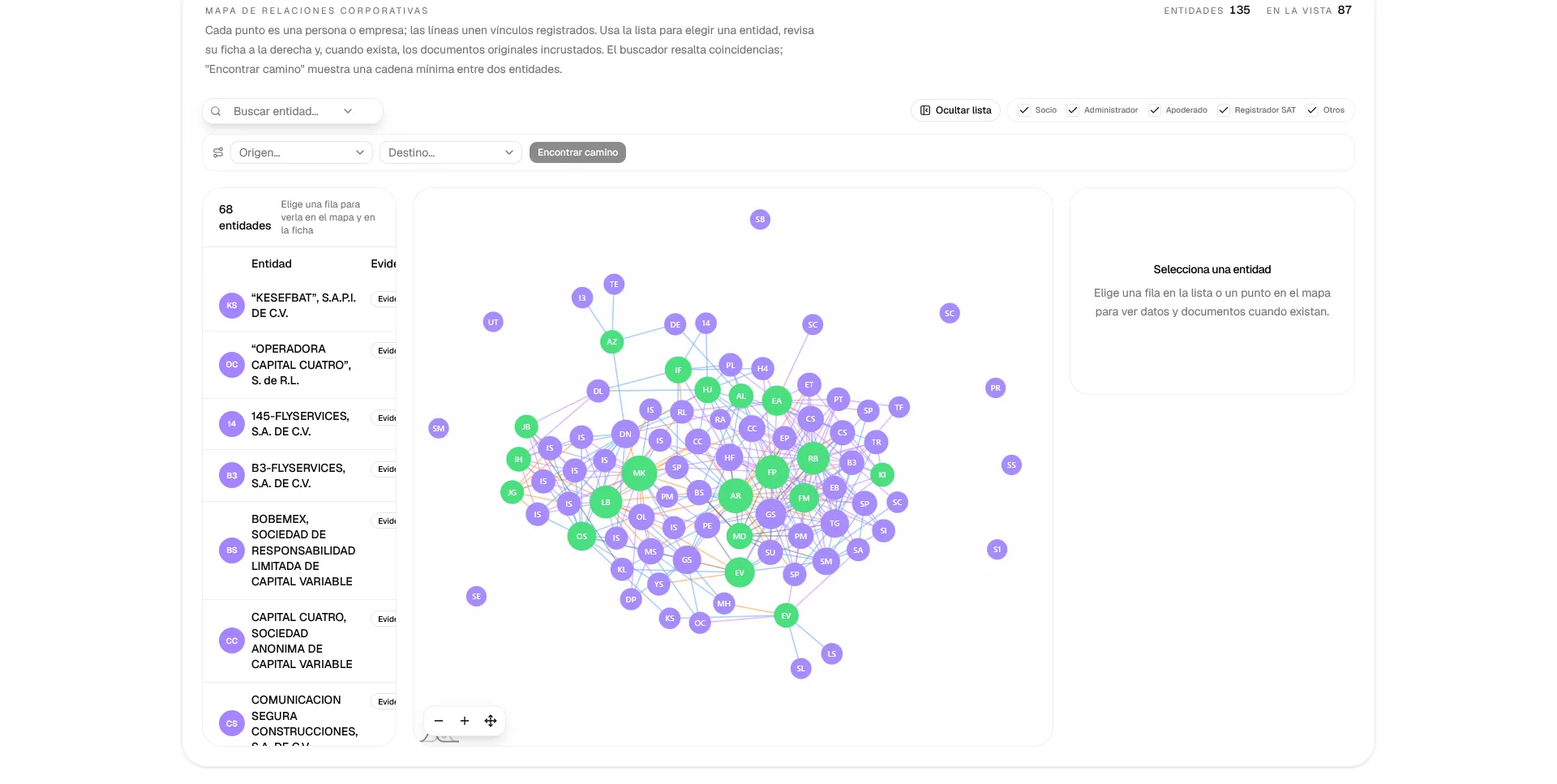
This business group has been contracted by 37 states and municipal governments for more than 52 billion pesos (USD 2,944 million) since 2012 for the installation, operation, and maintenance of cameras, control centers, and data analysis platforms. In Queretaro, payments to the group represented 86% of the state’s public security budget during the period analyzed. The weight of these contracts is especially visible in small municipalities.
In municipalities of Guanajuato, the proportion is even more extreme: Salvatierra allocated 65% of its security budget to contracts with Seguritech; Calle de Santiago, 78%; Purísima del Rincón and Jaral del Progreso, over 54%. In some cases, the transfer agreements reviewed for this investigation conditioned the use of funds on contracting the same provider.
Rafael Prieto-Curiel, a Mexican mathematician who worked as a crime forecast analyst at the Command, Control, Computing, Communications, and Citizen Control Center (C5) of Mexico City and currently investigates the dynamics of violence at the Complexity Science Hub in Vienna, warns: “We are betting on technology as if that is going to solve our problems of impunity, lack of trust in the authorities, and lack of reporting. The cameras alone don’t do the work.”
For Prieto-Curiel, video surveillance can be a cog in the machine, but not the central axis. He illustrates this with a metaphor: the capacity of a barrel is always limited by the shortest stave. “If you add resources to any of the other planks that protrude, no matter what you do, the capacity of your barrel remains that of the smallest plank,” he explains. In Mexico, he says, that critical point is not the technology but the impunity: without police investigations, without a reduction in corruption in prosecutors’ offices, and without public trust in institutions, the cameras do not change the underlying problem. “We need that, plus a whole system that changes.”
The evidence also shows limitations in its use for the administration of justice. Guanajuato, one of the entities with the highest investment in video surveillance with 4,281 cameras in operation, handed over just 191 videos for judicial investigations in five years, according to data from the National Census of State Public Security of INEGI. It is the lowest ratio among states with comparable infrastructure: Hidalgo, with a similar number of cameras, delivered 56,870 videos in the same period; Queretaro, 18,099. In both states, homicides increased by 130% and 95.5%, respectively, from 2012 to 2024.
The Lopez family —fictitious surname to protect their identity— waited six months for a prosecutor to review the camera recordings on a Celaya highway. They were trying to reconstruct the route of a vehicle linked to a disappearance. When the material was finally reviewed, there was nothing to analyze: several cameras were not working, and others had deleted the recordings months ago. Authorities did not explain how many devices were out of service or why.
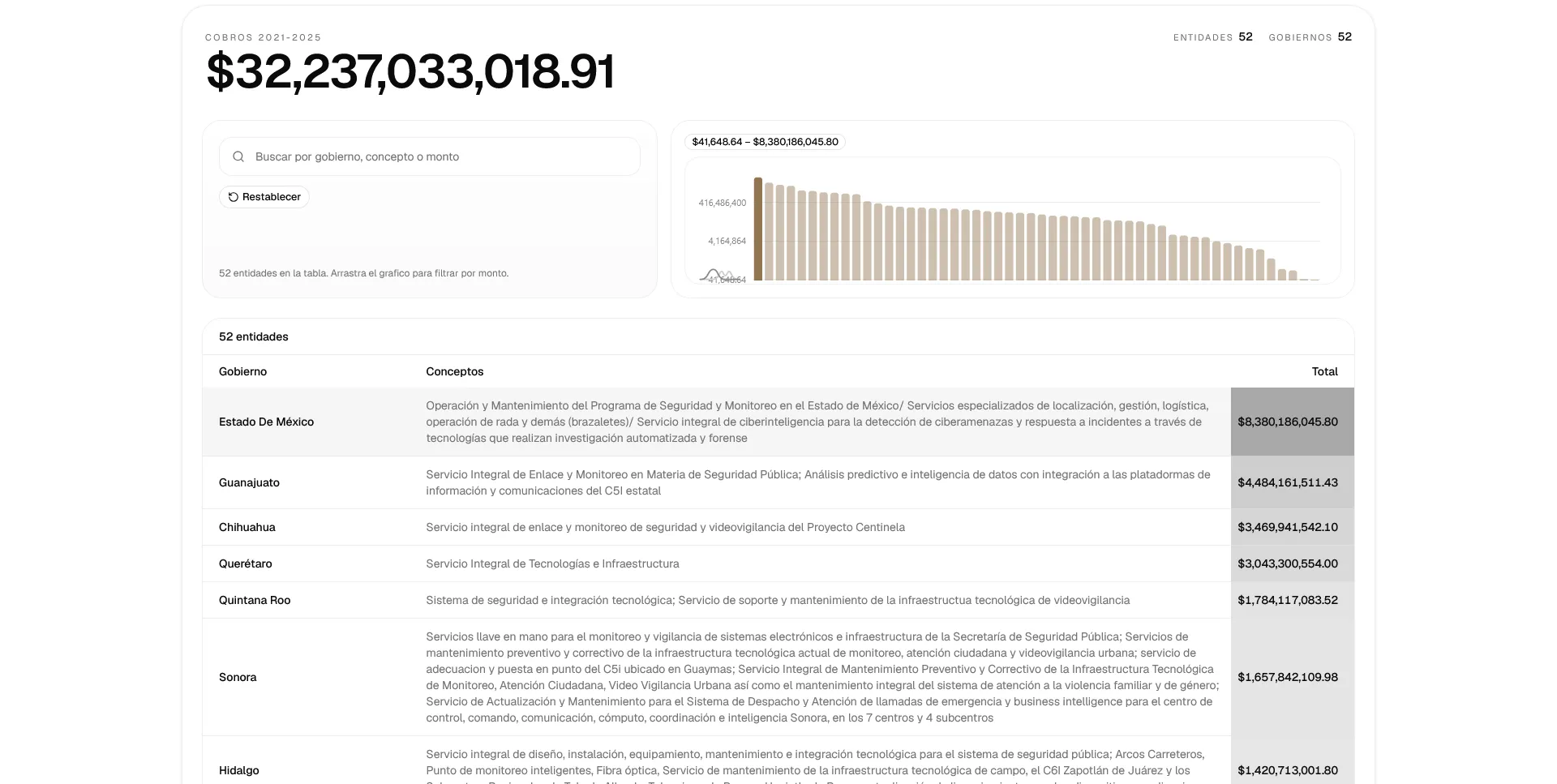
POPLab and CONNECTAS had access to financial documents and internal records from Seguritech Privada and Comunicación Segura —another company in the group— which show that, in the last five years alone, they have received government payments for more than 32 billion 237 million pesos (USD 1.865 billion).
Despite this, the perception of insecurity has increased or remains at high levels in several of these entities. In some cases, such as Guanajuato, it grew by more than 30 points since 2012; in others, such as the State of Mexico, it remains close to 90%, while in Baja California it increased by 20 points, and in Queretaro it doubled, according to the 2025 National Survey of Victimization and Public Safety Perception (ENVIPE in Spanish).
The states where the business group has been hired register an average of 4.21 on Mexico’s Peace Index, a measurement that assesses the intensity of violence based on indicators such as violent crime, organized crime, and the efficiency of the judicial system; a score closer to 5 indicates a lower level of peace. In 14 of the 19 entities analyzed, the security situation deteriorated after the implementation of these systems.
However, public investment in security technology has continued to increase.
According to mathematician Rafael Prieto-Curiel, the most critical points have not been addressed by the technological approach: “There is 100% impunity, a free license to kill —if you kill, nothing is going to happen to you—, overcrowded prisons, and zero social reintegration.”
At the same time, the weak link remains the police structure. According to Jorge Eduardo Cano Anaya, coordinator of the public spending and accountability program at the civil organization Mexico Evalúa, little funding has been allocated to the professionalization of the police, especially municipal police, as it is expensive “to increase their benefits so that they are more loyal to the police command and do not fall into other ‘payrolls’. When we stop seeing that and focus only on a technological issue, we are likely overlooking the fact that the greatest tool for achieving better security will always be the human factor.”
In 2025, Mexico had around 270,000 police and traffic officers, 2.1 per thousand inhabitants. But the biggest problem is wages, since the average of 6,620 pesos (USD 370) per month is lower than that suggested in the living wage studies of the federal government itself. That same year, payments made to companies in the group exceeded 5 billion pesos (USD 288 million), an amount equivalent to about a quarter of the total cost of the country’s police payroll.
While public spending on technology is growing, citizens are also bearing the direct costs to protect themselves. In 2024, private spending on security measures reached 78 billion pesos (USD 4.4 billion) in the states where the company has a presence, according to INEGI.
The other uses of surveillance.
For José Flores, communication director of the Network in Defense of Digital Rights (R3D in Spanish), an organization that accompanied journalists and activists to bring to trial those responsible for illegal communications interceptions using the Pegasus software, the deployment of technological capabilities is done under a promise to influence the reduction of crime, but its opacity makes it impossible to assess and know “whether the investment is being used well or whether other crime prevention and mitigation techniques could be more effective.”
But in other contexts, these systems are used, although not necessarily to combat crime.
In November 2024, in Tlaxcala, state authorities used the facial recognition video surveillance system contracted from Seguritech to identify feminist activists who participated in a protest. Subsequently, some of them were investigated by the local prosecutor’s office, according to Escenario Tlaxcala. The state government classified information about the operation and costs of the system as confidential; however, the records reviewed for this investigation document payments of more than 81 million pesos (USD 4.5 million) to the company for that purpose.
These monitoring tools have also been used in Jalisco to track social mobilizations. The local media, ZonaDocs, documented that the cameras have served to identify and prosecute people participating in protests. In that state, Seguritech has received at least 1.343 billion pesos (USD 75.5 million) for the maintenance of the C5 system—a platform that integrates surveillance cameras, emergency calls, and police databases— known as Urban Shield.
In Chihuahua, Seguritech operates the Sentinel Project through a contract signed in 2022 for 4.709 billion pesos (USD 264 million), one of the largest on record, which includes a 20-story watchtower built by the Seguritech in Ciudad Juarez, in which they will have a floor designated for North American security agencies such as the FBI and the DEA.
The system has around 10,000 cameras and license plate readers. It also has the ability to connect to private cameras, which would expand its reach to up to 30,000 devices. Despite its scale, access to the recordings faces the same obstacles documented in other states. Lawyer Leyver Montejo, legal advisor of the Paso del Norte human rights center, recounts how in most of the requests for recordings, they are told that the cameras were deactivated or not operating at the time of the events.
These cases show that technology not only has technical limitations, but that its use depends on institutional decisions that are not always aligned with the administration of justice.
According to security consultant and former security and intelligence official Bernardo León Olea, these technologies carry three structural risks: they are very expensive, which makes them fertile ground for doing business; their purchases are made with broad expectations to transparency under the argument of security; and it allows access to people’s information, which opens the door to uses other than those promised. “When there are no democratic controls, it is indeed a risk.”
Contracts in times of violence.
Governments of PAN, PRI, Morena, and Movimiento Ciudadano in at least 19 states have hired Seguritech Privada, some since 2012, betting on video surveillance as a visible response to insecurity. In most cases, the contracts survived changes in administrations.
The analysis of the contracts revealed a recurring pattern: 97% of the total amount was allocated through direct award, meaning without open competition between suppliers. Public tenders represent barely 2% of the committed resources.
Mexican law allows this mechanism under certain exceptions; these include cases where technical information could compromise public safety. However, this argument has also been used to withhold essential information that does not reveal specific details.
The transparency requests submitted for this investigation show high levels of opacity. Several departments omitted data on amounts, contract validity periods, or characteristics of the services. Twenty governments either reserved or denied the existence of contracts, although tax records show payments to the company of at least 3.577 billion pesos (USD 202 million).
Reviewed documents also show evidence of multi-year contracts, extensions of terms, and confidentiality clauses that limit public access to information.
To José Flores, "It's extremely irregular for a company to tell a government that it has to keep information confidential; there, a transparency committee should deliberate under the principle of maximum publicity, since it is in the public interest that we know what these technologies do.”
In some cases, contracts stipulate that the supplier will not be liable for technical failures in equipment considered "innovative," thus shifting some of the risk to the State. These types of conditions can generate technological and budgetary dependence, in which governments become tied to the same supplier for years, regardless of the results, according to experts.
The contracts themselves shield this opacity. In Chihuahua, the agreement with Seguritech states that the government “understands and accepts” that some equipment, due to its “high specialization, novelty, and technological innovation," may present failures that will not be considered a breach of contract by the supplier. In other words, the State contractually assumes the risk that the technology will not work, without any mechanisms to demand results or publicly document failures.
Paul Aguilar, digital security coordinator at the Social Tic organization, highlights a bias that makes technology services more expensive without evaluating their results: “If governments do not conduct research on their security needs, then the project design is left in the hands of the supplier, whose objective is economic profit. The company goes from being a product supplier to becoming a security analyst, without actually being one.”
The State of Mexico and Guanajuato stand out in this business relationship. Both governments began awarding contracts to the company in 2012, when the company still had little national presence. Over the years, the agreements were renewed despite changes in administrations. By 2025, these two entities accounted for more than 33 billion pesos in contracts, more than 63% of the group’s billing in that period.
Payments 2021-2025
$32,237,033,018.91
- Entities
- 52
- Governments
- 52
52 entities in the table. Drag the chart to filter by amount.
52 entities
Source: Own analysis based on Grupo Seguritech tax records.
At the same time, accessing the information generated by these technologies remains complicated for those seeking justice. Lawyers and search collectives report constant obstacles from prosecutors’ offices in obtaining recordings, which limits its use in investigation.
“A young woman was recently kidnaped on Boulevard Solidaridad in Irapuato, a road full of cameras, whose recordings were never accessible,” Bibiana Mendoza, a searcher for missing persons in Guanajuato, points out. The activist questions, "If video surveillance systems don’t serve the citizens, then who do they serve?”
And over time, this technology ceases to be an evaluable tool for public safety and becomes a structural expense that is difficult to review or modify, even if it is not reflected in results. “Victimization surveys, which are the most accurate way to measure crime, show that this indicator not only did not decrease but has actually increased. The dark figure —the crimes that go unreported— has not changed. The perception of safety, which is the key indicator, remains very high. People do not feel safe,” León Olea concludes.
In 2019, the UN Special Rapporteur for Freedom of Expression, David Kaye, proposed regulating the use and acquisition of surveillance technologies. The proposal did not resonate in Mexico. In the absence of clear rules on the procurement, operation, and oversight of these resources, the model has progressed without effective controls or public evaluation.
From Cano Ayala’s point of view, compliance audits are necessary to justify the hiring practices. “To see if they have fulfilled what they promised, if there has been a direct impact on public safety. We would have to see if maintaining the contract is justified, and, especially if we’re talking about several presidential six-year terms, there would most likely have to be more competition to see if there is another company that has the capacity to provide the same service at a lower price.”
Currently, there is no regulator for this industry, unlike what happens with arms manufacturers. “The security industry is first and foremost a business that doesn’t care about effectiveness,” José Flores, spokesperson for the Network in Defense of Digital Rights, points out.
However, the security crisis in Mexico is not subsiding. While the authorities celebrate the decrease in the homicide rate, human rights organizations are concerned about the rise in disappearances. Extortion of businesses paralyzes entire industries in several states, and reports of femicides and gender violence are increasing, mainly due to greater visibility. Faced with all of this, the preferred response of governments is to increase spending on technology.
“The problem isn’t just the existence of these technologies, but the entire political and profit-driven environment surrounding them, because in the end they generate a lot of money; they seem to be the perfect business,” Paul Aguilar concludes.
---
For this investigation, Ariel Picker and Daniel Esquenazi were contacted to address specific questions about Seguritech's business model, the company's trajectory, its contracts with state and municipal governments, and its outlook on the technology security sector in Mexico.
At Esquenazi's request, written questionnaires were submitted; the company indicated that its lawyers would review the questions and, one day later, that an advisor would handle the responses. The company committed to delivering the information by the evening of Tuesday, June 2. At the time of publication, no response had been received. The company was informed that its position, if provided, would be published in a subsequent article.